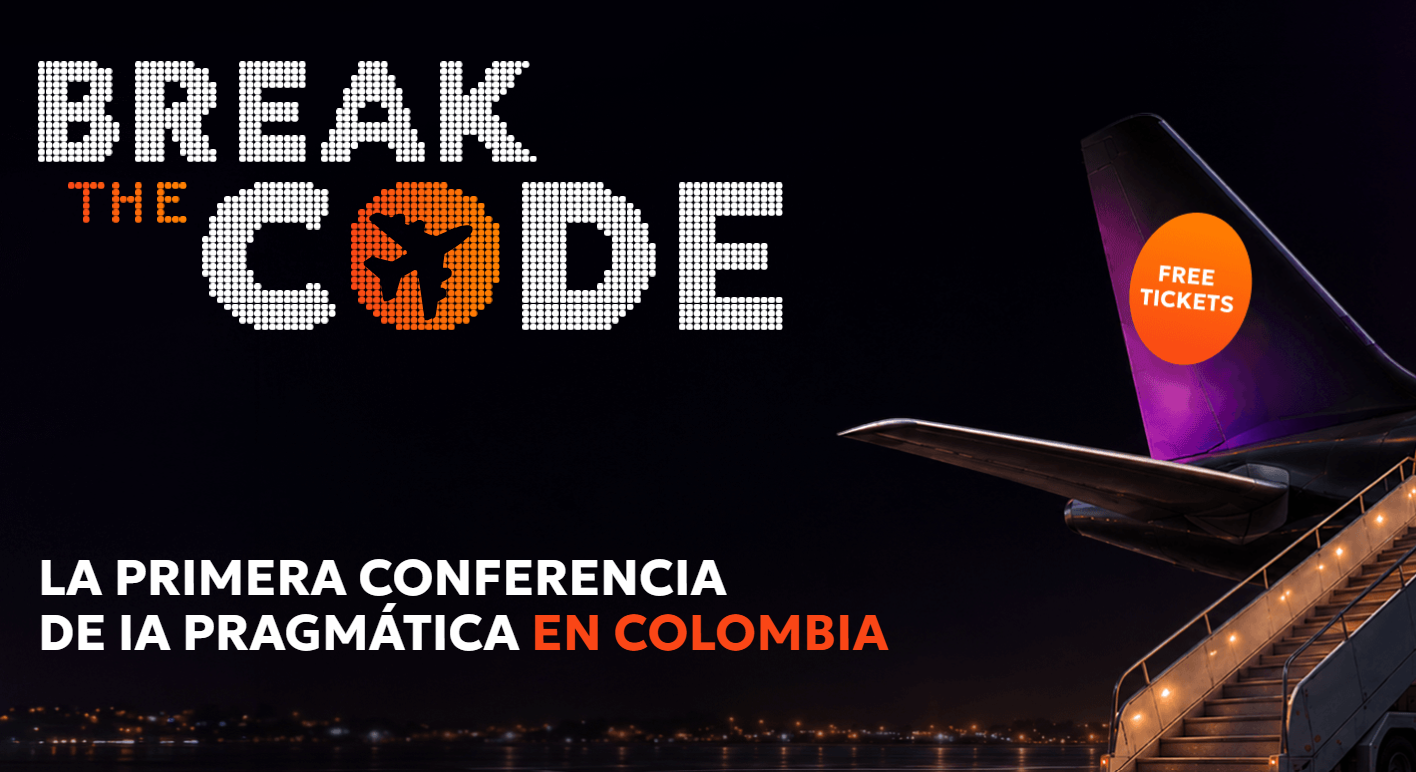
Notes from Break the Code, the pragmatic AI conference N-iX organized in Medellín.
Before walking into the event I asked Claude on my phone what the best use of those hours would be. The answer was simple: take notes and write a short post. Here it is.
It felt like the right start, because it sums up what came up again and again at the event: AI doesn't replace judgment, it helps you decide where to put it.
The bottleneck moves
In the age of AI agents, writing code stopped being the hard part. The bottleneck doesn't go away, it moves. I saw it move to four places.
To context. A model without context gives generic answers. You have to put knowledge in context and connect the model to what you're actually doing. Massimo di Cesare showed an app that works like a git for the brain: it keeps, through voice notes, what matters and what your head shouldn't have to hold.
To data. Poor-quality data feeding models, and little attention to which data leaves for them. One line summed it up: it's not the model's fault, it's everything around it.
To people. The profile in demand is the product engineer, someone who puts the business outcome ahead of the technology. And there's a real skills gap: teams holding COBOL or AS/400 knowledge, and roles shifting from DevOps to AIOps that leave knowledge behind.
To communication. Telling the business what can and can't be done. Having the uncomfortable conversations because they're necessary. And selling what the client actually needs: "we sort your alerts" instead of "the system fixes itself".
What stuck with me
Prompt versioning. If a prompt decides how a system behaves, it deserves the same history and the same review as code.
And the model router. During Massimo's demo, someone in the audience suggested a router as the next step: send the simple work to cheap models and save the expensive ones for what really needs them. They mentioned Jev, from TypeSafe AI, a "System One" model that doesn't generate text. It takes a state and a set of options, and returns a typed decision with its probability. I wasn't sure how it all fit together, so I asked during the Q&A.
Other lines I wrote down:
- Every first deliverable is a draft.
- If I truly understand the system, I should be able to defend it.
- Everything fails. The question is how you iterate.
- What's the end goal, and how am I measuring it?
How I'm applying it
- Version my prompts. My agents already live in git next to this blog's code. The next step is treating every prompt change like a code change, with its reason.
- Try a model router. Simple work to a cheap model, complex work to an expensive one, and measure how much I save without losing quality.
- Start with the pain. In consulting, before talking about AI, understand what's hurting the company, keep the proposal simple and focus it on that specific need.
Thanks to N-iX for organizing Break the Code and for bringing a down-to-earth conversation about AI to Medellín.